


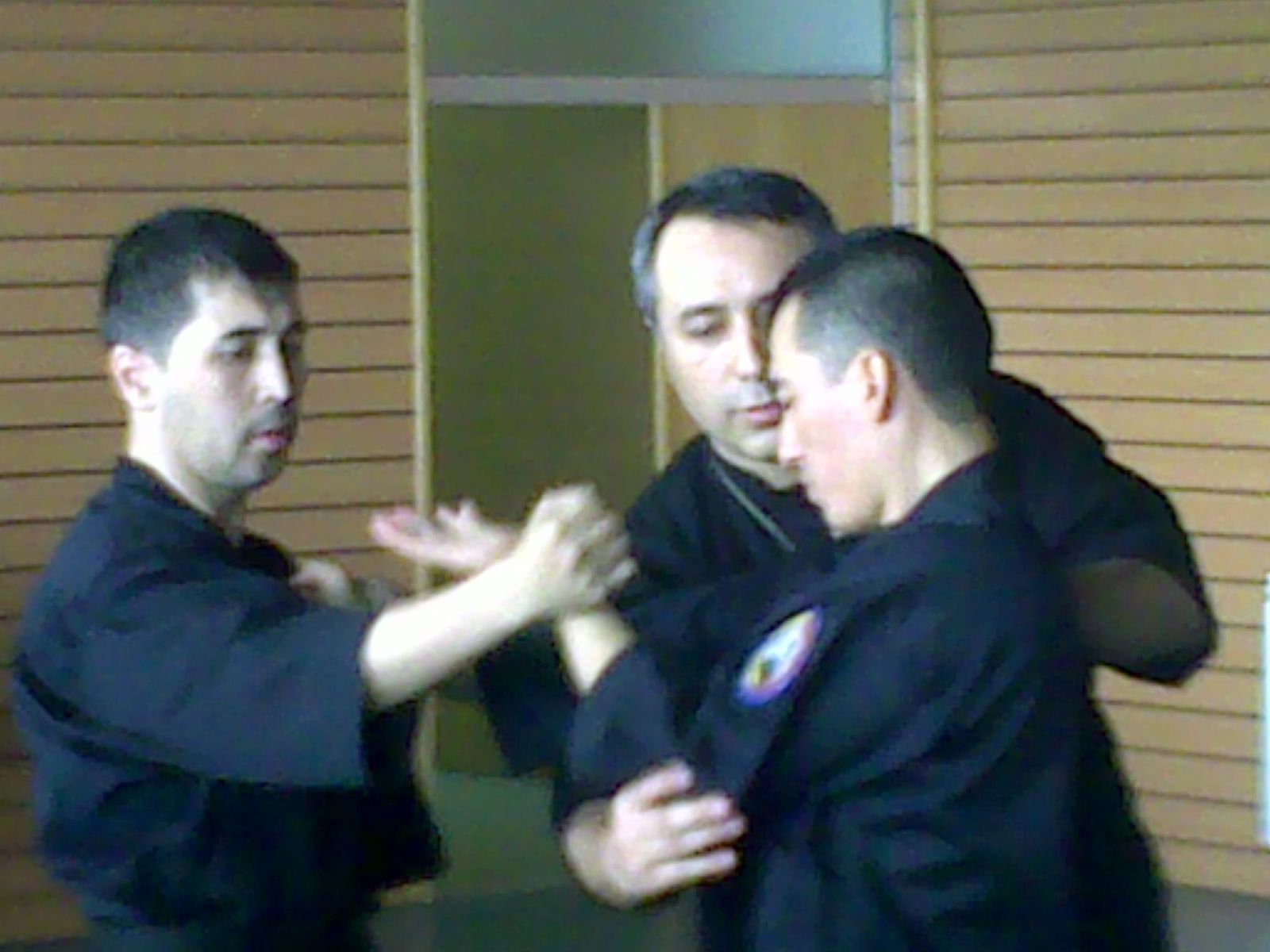
 The strength of the Wing-Chun structure comes from proper alignment of the body to the opponent. By maintaining this alignment, structure and balance remain intact. The Wing-Chun practitioner seeks to destroy his opponent’s structure and balance by constantly moving, maintaining his 6 harmonies, while disrupting the opponent’s alignment.
The 6 harmonies refer to the alignment of the shoulders, elbows, wrists, hips, knees and ankles of these, the challenge comes in maintaining alignment of the hips, shoulders and arms as your body, and that of your opponent, move around.
The shoulders and hips should be facing the opponent. The Man-Sao should out in front of the body, centered between the shoulders. Perhaps the most apt conceptual analogy is thinking of the hips as the rear gun sight, and the Man Sao as the front gun sight.
This concept is seen in Tai-Chi and Ba-Qua-Chang as well, referred to as the “cylinder/spiral movement”, where the upper body is constantly turning during movement to maintain alignment, and thus, inner power.

