


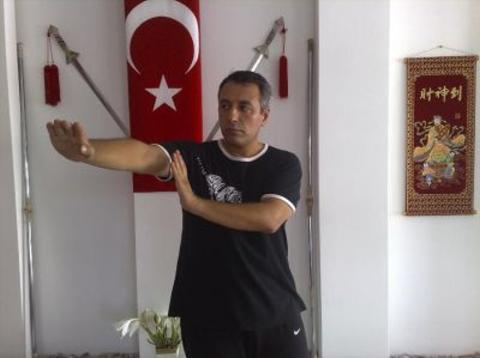
 Chuen-Ma, or Turning Stance, is another unique key element in Wing-Chun. Chuen-Ma is executed as a response to the attacker pressing in, resulting in the attacker being diverted to the side. The alternative would be either to wrongly allow your block to be compressed into your body (thereby destroying your structure) or to move back.
Chuen-Ma should not be executed unless the attacker is pressing in. However, Chuen-Ma could be executed prior to the opponent’s attack along with other footwork such as Sam-Gok-Ma or Sik-Ma (Sip-Ma) or Chong-Ma to move triangularly or cicely within but not away from the opponent to avoid such powerful forces due to the size of the opponent. Chuen-Ma is subtle, turning only as much as necessary. The more the practitioner turns, the longer it takes to return with an attack.
Never allow your blocking arm to be compressed into your body as you turn; there should always be forward energy (forward to your centerline with the consistent of the six harmonies). As the waist turns, the entire upper body turns by necessity, allowing any block or strike to carry the momentum of the body turn. This is critical in e.g. Lop-Sao Drill. The wrong alternative is to initiate with a block or strike with the arms and shoulders, following with the waist turn.
For techniques that allow Lin-Sie-Die-Dar (simultaneous block and strike, e.g. Tan-Da, or Gan-Da), the practitioner will have 2 centerlines: the practitioner’s centerline which is in front of his body in the direction which his shoulders are equally facing; and the combat centerline which is in the direction of the opponent.
The Wu-Sao, or defending hand, should always be kept between you and your opponent as you turn.
Chuen-Ma is a transient stance, as the Wing-Chun practitioner will quickly re-establish a forward stance by stepping around and through the opponent, dominating the centerline.

