


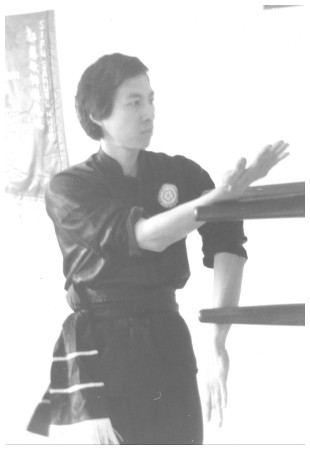
 Through generations, Wing-Chun Kuen has managed to retain its focus as a practical fighting art. It has avoided being modified into a competitive (rules based) point-scored sport or demonstration art. The most devastating Wing-Chun strikes (eyes, throat, groin, and knee) are far too dangerous even for freestyle competitions. Wing-Chun tournaments are rare or unknown to public and martial arts community. Therefore, its competition is rarely seen.
Wing-Chun is not just a collection of unrelated forms and techniques. It has a core set of guiding principles which allows practitioners to decide what correct or incorrect Wing-Chun is. This keeps the art a pure and integrated fighting system, while allowing direction for refinement that is consistent with its principles.
These guiding principles are strictly practical and are part of the reason for Wing-Chun’s uniquely scientific and logical approach to fighting. The nature of Wing-Chun is such that it is quite easy to accept that a woman did indeed have some role to play in its development. It is an extremely logical, scientific system, which always makes use of skill over strength, economy of motion over flowery motion, and is well suited to someone of smaller stature and strength.
All Wing-Chun techniques serve a practical purpose. There are no flowery movements or graceful techniques that mimic animal movements like others popular Kung Fu style such as Hung Gar. To the uninitiated, Wing-Chun does seem to appear less effective comparing with more dramatic styles, like Shao Lin, Karate, Tae Kwon Do, or Wu Su; Its techniques are simplified to the max to train the students to defeat the opponent in the most efficiency way (economy of motions), therefore, Wing-Chun practitioners pride themselves on plain-looking but deadly effective techniques.
In practice, the techniques of Wing-Chun may be interpreted and understood either in terms of body mechanics or in terms of Fa Ging (explosive force). Wing-Chun does differ from most internal styles in that Wing-Chun training is generally vigorous, fast and forceful and often works well with partners. While some say that, even tense, it is possible to use Wing-Chun; such an unsophisticated approach is easily defeated by a skilled Wing-Chun practitioner. Such skill does not come automatically. The difference in the application of techniques can be subtle. Proper instruction is crucial.
This is not to say that Wing-Chun relies on brute strength. On the contrary, softness (via relaxation) is fundamental to the style, and essential to deflect, negate, and use an opponent’s power against him. Many people are new or have little knowledge of Wing-Chun usually question the practitioner’s ability how to generate powerful strikes via softness and relaxation during the training. Being relaxed while training does not mean that Wing-Chun strikes are soft, its motion is like water but strike like a brick wall.

